for what it is worth. I believe in capitalism and the right to make money from land deals. If the city wants to pay $1 million for the property they propose putting a road through and the owner takes it, well, good for him! If they want to buy land from 10 Wilmington Place and spend $100,000 moving the pergola structure at the apex AND the owners of the property agree to this then that is OK in my books too. I don't think they want to do that though. In fact, I don't think the planners have a plan at all. They submitted something to the State for funds with no real plan in place so they got the money with a bold LIE!
If nobody got wind to what they had done then they would have tried to acquire the brick house on the hill by imposing eminent domain. With this plan proposal they would have tried to buy it for fair market value which would be considerably less if it wasn't listed on the National Register. In fact, it would have had less value because of the proposal! Well, they won't be able to touch that house and they know it. Now they say that they will move the pergola structure back 20 feet at the apex of the Y but have no clue that this structure was put on the National Register with the main building in 1979. I have been trying to tell the city engineers this but they don't want to hear it from me. I have suggested in November that they have a public meeting NOW to find out what problems they will face so that they can re-allocate the funds to a truely worthwhile project in the city. So I set one up in December 2005 and they rebuffed "That is too soon. January would be good". So I set one up in January and they said that they "needed time to put a few proposals together". So I said screw it! Let them drag their feet and I will slap them with the details when it is too late to try to reclaim the funds for another project. I believe that this one is a complete waste of money and that any congestion can be fixed by re-calibrating the traffic lights and putting up a "No left turn between 3-6PM" sign or by closing off Stewart Street as has been suggested and removing the one set of lights. If they want to pay me $1.9 million for that advice then I would be happy to take it.
Then I got clever. I spoke with one of the city staff at our priority board and asked them to set up the meeting. See, now it looks like this enterprise has been initiated by the city. To my surprise, it worked AND they have agreed to have the meeting at..... wait for it... 10 Wilmington Place! The Heart of it all!
Widening Wayne Avenue and putting in a center turning lane from Anderson to this junction isn't a real problem. There are grass verges on both sides of the road that could be eliminated but the cost to move all the street lamps would be excessive. The problem arises when they try to widen the turn onto Wilmington Pike which is currently one lane coming out of the city widening to two lanes at Beckman Street..
What would I like to see happen? To be truthful, nothing. I think it is a waste of money.
If 10 Wilmington Place is agreeable then that would be my other option. They do have the land to give up but that pergola structure would be in the way and they would have to agree to move it. I am not opposed to the idea of improving this junction if the affected parties are agreeable to the plan. I will say that I don't approve of how this project acquired its funding though. I am of the opinion though that the city will proceed with this project whether or not it is necessary. They will proceed with it whether or not the general public opposes it. See, they need grants to stay in business. They can't make make enough money from taxes so they apply for every grant that they can get. Unfortunately many of the grants are designed to help low income families buy $160,000 homes in a city where homes sell for $40,000 to $90,000. Middle income families can't afford these homes for low income families and if they could, don't "qualify" to buy them. We have grants to help the homeless but no grants to help the people who pay city wage tax! The middle class has left the city. The city offers them nothing so they sell up and move and if you do decide to buy historical property and keep it they come up with a grant that gives them an excuse to knock it down to build a road that helps only people living outside the city.... see, they were willing to lie to get the money. I'll bet they are willing to lie to get to keep it.
Thứ Tư, 1 tháng 2, 2006

Thứ Hai, 30 tháng 1, 2006
We interrupt this blog for a public service announcement.....
Window repair 101. Part Three
Remember this?
Remember this?
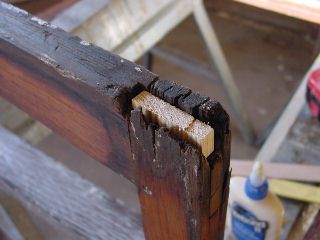
And This?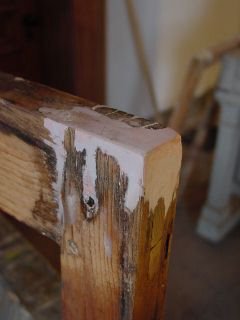
Well, now it looks like this...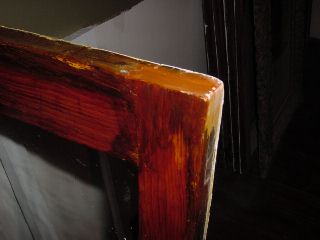
The bondo was painted to match the water stained part of the wood using acrylic paint and then the inside of the window was given 4 coats of shellac. I didn't bother trying to mask the repair on the edges of the window since they won't be visible. The outside of the window was painted white. I don't need to waste a picture on that I'm sure we all know what white paint over "bondo" will look like!
Next, glazing! Ooooh, so exciting.....
I've finally gotten really good at this after doing some 20+ windows over the last 5 years. Besides a can of glazing putty, you need one of these;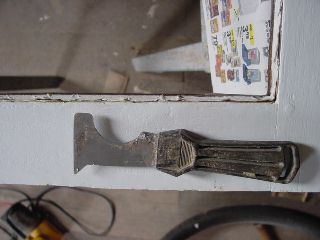
a glaziers putty knife.
This is very important. If you try to use a regular scraper or your fingers then you will get less than quality results based on your own talent and ability. With one of these you should be able to re-glaze a large single frame window in about 30 minutes. A six paner will take longer. Of course you can cheat and buy a tube of window caulk but the stuff isn't the same as good old linseed oil based putty. Firstly, you don't get to know what it is like to have gooey putty all over your fingers. Secondly, linseed putty allows you to screw up over and over again. You just roll the stuff up and start over with no waste (except the stuff that stays on your hands). Besides rolling the putty in your hands to get it warm and loose, the key to getting a good seal is putting a small amount of putty on the wood ridge that supports the glass to provide a bed that the glass can sit on. If you look at the picture above you will see a continuous smudge of putty around this ridge. After you place the glass in the frame, you need to lock it in place with glaziers points. I prefer the modern ones with the two side "risers" that allow you to use a putty knife to push the point into the wood. If you use the old style triangle flakes then there is a very thin edge to push your blade against and a risk that you will break the glass. (I know, I have done it!) To finish off you need to place a roll of putty along the edge of the pane of glass and the frame and press it in place with your fingers or the long flat edge of the putty knife. To finish and get a good smooth bead of putty you need to draw the short flat edge across the length of the putty bead using your forefinger to apply pressure on the short edge of the putty knife. This blade needs to be at a sharp angle because you only need adequate putty to hide the glaziers points. As you draw the blade back you can use the back edge to cut the excess putty on the glass and with pressure you can utilize the inside edge of the frame to cut away the excess putty on the upper side of the original bead. The edge of the blade should be resting on this as a guide. If you draw back about 8 inches at a time and remove the excess it will be a lot easier than trying to complete a whole edge in one go. It may take two passes to get the final bead right and you can smooth out any rough spots using your finger. If you want to you can dip your finger in some paint thinner. I tend to just rub mine quickly up and down in short strokes along the putty to get a smooth edge against the glass. The sharp edge of the putty knife is useful to get perfect corners and when it comes to cleaning off the excess putty on the inside of the window as a result of pressing the glass into the putty "bed". When you are done it is also useful when removing putty from your fingers and for cleaning your finger nails....
Thứ Sáu, 27 tháng 1, 2006
Pergolas and more "house on the hill"
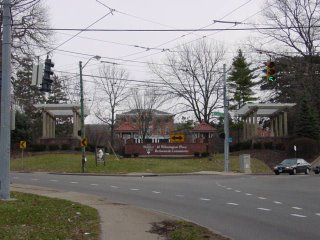
Here are some more pictures for the "Suspense" series. The pair of pergolas and sentry boxes at the apex of the infamous Y.
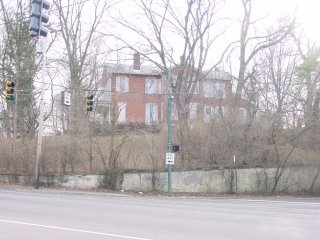
A picture of the "House on the Hill" from the same vantage point.
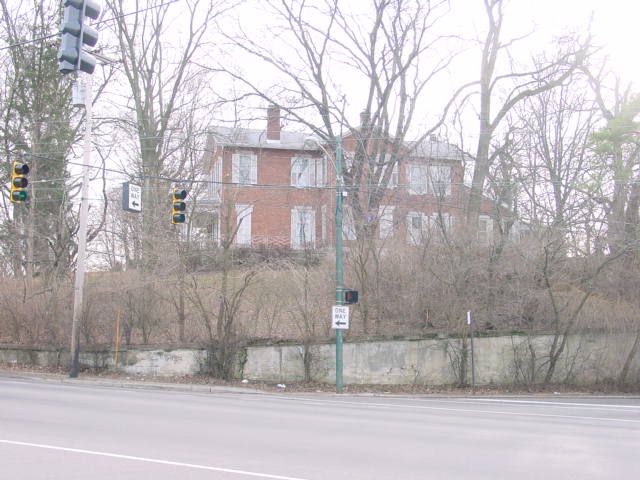
Soon I will post my opinion on the subject. Can you guess what it might be?

A picture of the "House on the Hill" from the same vantage point.
Soon I will post my opinion on the subject. Can you guess what it might be?
Suspense! The Details....
Look at the map again.
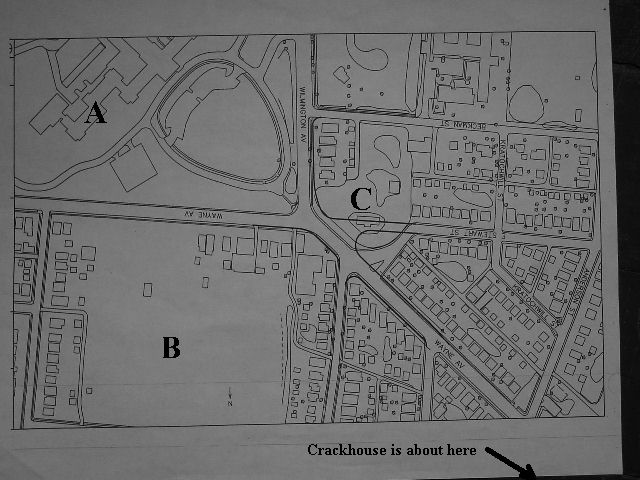
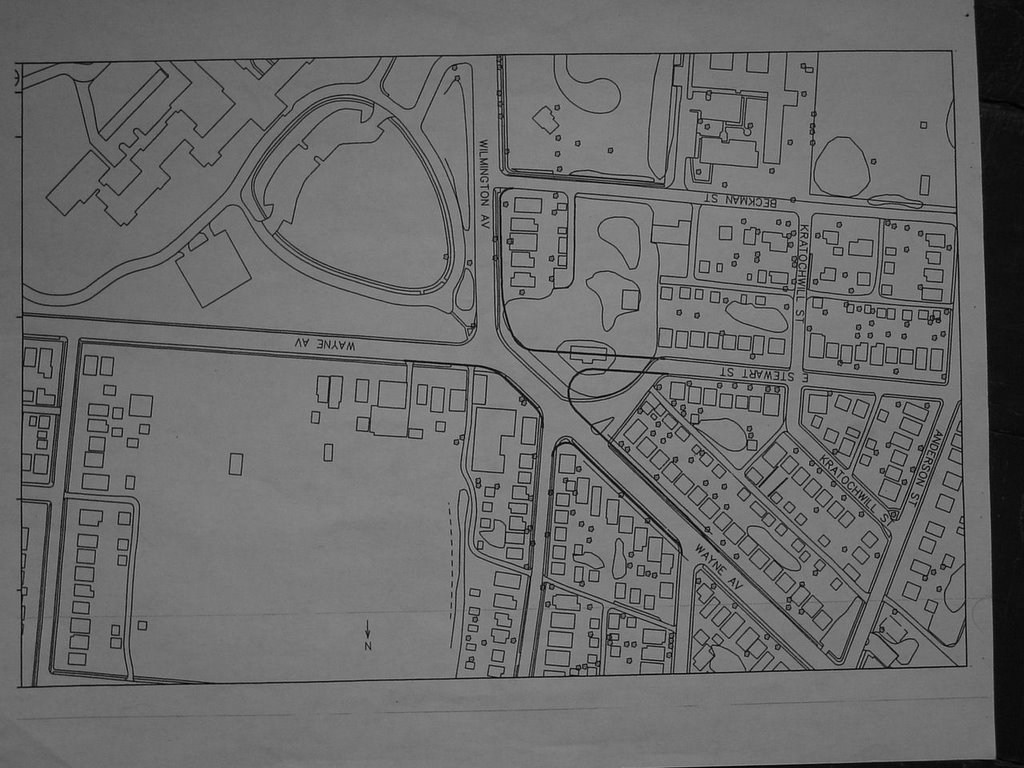
That large area in the top left corner (marked A) is 10 Wilmington Place. This is a retirement community. The structure was formerly the Southern Ohio Lunatic Asylum built in 1855 and placed on the National register in 1979. Samuel Edgar, the guy who built our house bought 8 acres of this land and donated it to the State of Ohio for this purpose in 1852. So we have a connection to this after all! The large open area in the bottom left (marked B) is Walnut Hills Park, owned by the City of Dayton. The structure that the proposed highway goes through (marked C) is a large house that sits on a hill about 30 feet above Stewart Street. The current owners of the property bought it in 1993 and plan to spend the rest of their lives there. The house was built in 1871 by a guy named Jonah Bull who bought the land from, you guessed it, Samuel Edgar. He had to sell it at sheriffs auction in 1881 because he owed creditors over $8000. The house is brick and the adjacent barn has hand hewn beams dating it to around 1830. Here is a picture of the house. Taken last year.
The owners had no idea this plan existed. They do now, though and have since May 2005 when I informed them. Should they choose to sell the house, well, they can't. They would have to disclose that this plan exists to a new buyer and it is not likely you would buy a home if there was a possibility that it would be seized from you in a few years. In order to save the house it was nominated and qualifies for the National Register and will be placed on it soon. For those who don't know, this eliminates the possibility of eminent domain being invoked by the city or the State. Only the federal government or the property owner can do anything to this property.
Construction at this intersection is scheduled to begin in 2009. Under normal circumstances the plans and proposals are to be presented in 2007 for public scrutiny. If the owners of this property were not made aware of this plan before then it may not have made the National Register.
So, take the land from the old State Hospital site you might say! Well, at the apex of the Y is a structure consisting of a pair of sentry boxes and a pair of pergolas that used to sit along both sides of an entry road.
This is also on the National Register! Looks like we have a bottleneck starting to appear, doesn't it?
More details; the population of the city has gone down considerably in the last ten years while that of the region has remained constant. Note, it is not increasing. In fact it is slowly decreasing. New development is going on in counties surrounding us but jobs are not being created in the city. Newest developement will be in the Northwest and not the Southeast where we are.
Traffic counts indicate 25,000 cars a day travel Wayne Avenue. I assume that means 12,500 each way. Not all of those vehicles pass this intersection. There were counter strips placed all around this junction 2 weeks ago so I'm sure the city is getting their number counts up to date.
More facts; residents on the one way part of Stewart Street don't want two-way traffic because they won't be able to park their cars on the street.
Coming out of the city there are 5 traffic lights along a 1 mile stretch of Wayne Ave before you get to this junction. This junction would make 6 lights. Three of those six traffic lights are in the area shown by the map, at Anderson and Wayne, Stewart and Wayne and Wayne and Wilmington.During peak times left turns from Wayne to Wilmington and Wayne to Wayne are awkward but traffic keeps moving.
Any questions? I will post a picture of the pergolas later. So check back!
Thứ Ba, 24 tháng 1, 2006
Suspense! The plan.....
There are two players in this plan. The City of Dayton and the Miami Valley Regional Planning Commission. The facts:
Project sponsor: City of Dayton
Project Name: Wayne and Wilmington Intersection Improvements
Project Location: Intersection of Wilmington Ave, Wayne Ave and Stewart Street
Project Description: Realign Stewart Street with Wayne Avenue and convert to two-way, widen Wayne Avenue and Wilmington Avenue to 5 lanes.
Someone has had their eye on this intersection for a long time. They would probably like to get home 5 minutes sooner due to congestion on Wayne Avenue at rush hour. Work on this junction was ranked #6 on a list of 12 priorities for a 30 year plan.
The junction is unique. It is a Y on a main route into the city. The fact is, it has been this way for over 100 years. It has been here since 1850 and Stewart Street (formerly Union Street) appears on the 1918 Sanborn Fire Insurance Maps in its present curved shape.
In the 1980s some of the side streets and the part of Stewart Street from Kratochwill to Wayne Ave were turned into one way streets.
There have been several meetings over the years to design a proposal for this junction but nothing acceptable was ever produced. So, in order to guarantee that work could be done on this intersection an application for $1.32 million in federal funds was submitted to the State of Ohio in 2004 with the following plan. This plan was devised sometime around 1964 when Dayton and Kettering were hot beds of employment in the region. Obviously this junction was considered a problem then and nothing has ever been done. The dark lines indicate the proposed changes. If you are familiar with this intersection then you know what this plan proposes. If you aren't, and that would be the majority of readers, you will have to wait for the next installment for more information!
Project sponsor: City of Dayton
Project Name: Wayne and Wilmington Intersection Improvements
Project Location: Intersection of Wilmington Ave, Wayne Ave and Stewart Street
Project Description: Realign Stewart Street with Wayne Avenue and convert to two-way, widen Wayne Avenue and Wilmington Avenue to 5 lanes.
Someone has had their eye on this intersection for a long time. They would probably like to get home 5 minutes sooner due to congestion on Wayne Avenue at rush hour. Work on this junction was ranked #6 on a list of 12 priorities for a 30 year plan.
The junction is unique. It is a Y on a main route into the city. The fact is, it has been this way for over 100 years. It has been here since 1850 and Stewart Street (formerly Union Street) appears on the 1918 Sanborn Fire Insurance Maps in its present curved shape.
In the 1980s some of the side streets and the part of Stewart Street from Kratochwill to Wayne Ave were turned into one way streets.
There have been several meetings over the years to design a proposal for this junction but nothing acceptable was ever produced. So, in order to guarantee that work could be done on this intersection an application for $1.32 million in federal funds was submitted to the State of Ohio in 2004 with the following plan. This plan was devised sometime around 1964 when Dayton and Kettering were hot beds of employment in the region. Obviously this junction was considered a problem then and nothing has ever been done. The dark lines indicate the proposed changes. If you are familiar with this intersection then you know what this plan proposes. If you aren't, and that would be the majority of readers, you will have to wait for the next installment for more information!
Thứ Hai, 23 tháng 1, 2006
Keeping you in Suspense
In case you didn't know, I am the president of our neighborhood council. I am also an elected representative of our local Priority Board which basically gives citizen participation in local government. Well, I have a burning issue that needs to be made public. It involves deceipt, $1.9 million in funding, historical landmarks, waste of public money and the potential abuse of eminent domain. It is scheduled to happen in my neighborhood in 2009. I am in the process of trying to thwart it. We have a public meeting scheduled for February 23rd with the City Planners. It should be an interesting song and dance routine since they have been called out with egg on their face!
I will post the facts shortly, just as soon as I feel that I can present them in an un-biased manner. In the meantime, you must all be kept in suspense! Nothing like a good "Cliffhanger" to add excitement to your day!
I will post the facts shortly, just as soon as I feel that I can present them in an un-biased manner. In the meantime, you must all be kept in suspense! Nothing like a good "Cliffhanger" to add excitement to your day!
Chủ Nhật, 22 tháng 1, 2006
Đăng ký:
Bài đăng (Atom)